The title probably makes it sound like I'm going to talk about some controversial topic that I've just been holding back on for beyond my limits. Maybe it would have been a good title to boost my statistics had I actually be making any money on these posts. Where it is actually coming from is, for the past year I've spent a lot of my time keeping closer with the students in my classroom, my family and in collaborating with the teachers in my building. I became a little turned off from the self-promotion and "making a name for myself" attitude that I was seeing more of in the edu sphere and creeping up in myself as well.
I had a chance to catch up with a good friend last night on the phone that also happens to be in education. Talking with him some about this he reminded me that it is still important to share our experiences with other teachers for the sake of the kids and improving our schools for them. So that being said, even after 12 years of teaching, I still feel like I don't know what I'm doing but will share a new post on where I am today and the journey that I hope is ahead for my classroom.
I'd like to believe that my classroom is centered more this year and last on conversations between students 70% of the time each day. That as often as I can I'm providing activities that first help them to explore and build their understanding that at some point tip toward developing efficient and meaningful math skills development and solid mathematical thinking. I am thankful for the continual improvement of resources like Desmos' Function Carnival in having some engaging ways of doing that in a way that is fun for kids. I also like the idea that it isn't just the typical edtech garbage--that there are good math people I know under the hood developing it in a thoughtful way.
This year in my professional reflection process I'm desiring to make a better connection to activities like this and what we are learning rather than just having isolated fun, engaging things that don't really move my students to a better understanding of the other class stuff we do.
Today we are unpacking what we did yesterday through function carnival and my hope in this activity was to lead kids to develop the skills necessary for future success based on what they explored yesterday. This lesson started with students thinking individually, sharing with their partner and then having a large class discussion for the first 10 minutes of class and then partners moving forward at their own pace, discussing and writing their responses. I was free to talk with groups as the need came up and pulled us together as a group as it seemed necessary.
I think this is an area that we need to get better at as teachers--myself included. Yes, still trying to incorporate explorations and investigations but then getting better at connecting those activities to learning and use of those skills learned in future learning opportunities. Maybe in sites like Function Carnival there could be a teacher lesson pool that we could start sharing ways of getting to that with students?
Showing posts with label discussion. Show all posts
Showing posts with label discussion. Show all posts
Thursday, December 4, 2014


Wednesday, May 7, 2014
Open-ended discussion on "Rules of exponents"
So earlier this week I read this post by Andrew Stadel and was challenged to approach the rules of exponents in a more perplexing way. First of all, starting with the mistakes and what kids already know about exponents was a great launching point for this lesson. I made my own 4 question mistakes not really wanting to get into exponents of zero, negative values or fractions just yet.
The following statements are all INCORRECT.1. Identify the mistake(s).2. Correct.3. Justify (show) your reasoning.We spend a large majority of the time on question 1 in the last hour and somehow managed to get to fractional exponents. Different from earlier classes today, I started my last class by saying there are two levels of answering these questions:
1. 43 · 42 = 165
2. (34)2 = 36
3. x3 · x2 = x6
4. x2y3 = (xy)5
1) You grab a calculator and find the value of each side and say "These numbers are different, so it's wrong".For number 1 I had students say that the value should be 45, 210 and 322
2) You apply what you already know about exponents and come up with an explanation that someone who knows less than you about exponents can understand.
The fun came in asking students to explain why 45 was the same as 210 in visual form. Most at first said that because you take half the base number you must double the exponent but we needed to know why to develop their understanding.
One student explained by pairing up the two's to make 4's by multiplication and stating there were 5 groups of these pairs--the whole class applauded his explanation after gasping that they got it.

So then we went to why 45 was the same as 322 and a girl student did this (again applause from the class followed):

Realizing we were getting dangerously close to logarithms in my 6th grade Algebra class I pushed the envelope and asked what the exponent would be in 8x = 45 and they jumped right in!! Some students naturally assumed it was 2.5 and stopped but others weren't satisfied.
A girl student in class offered to come up and draw a picture of what she thought was happening and we got this to look at as a class:

Her picture was an excellent launching point for discussion in thinking about what to do with left-over factors when we try to group to get factors of 8. Her mistake actually brought out a big difference in fractions vs fractions as exponents when another student tried what she said in his calculator. The class came to consensus that for the exponent, since it would take 3-2's to make another factor of eight the exponent should actually be 3 1/3 instead of 3 1/4.
Wow. Great class, fully engaged students and some great thinking going on driven by the students.
Friday, March 7, 2014
Triangle Inequality: Introducing a learning target in context
In starting a new unit today I wanted to give context to students for writing inequalities. In our algebra class students have not yet learned the triangle inequality theorem which states that:
In anticipating the pacing to be different for each student I made the activity as a Google presentation and provided students the link, instructing them to do their work on paper and answer completely any questions asked of them in the activity--noting that I would be breaking in periodically to the whole class and facilitating some discussion.
My favorite part was #4 of the first drawing where many of them grew frustrated with not being able to construct a 1 cm, 2 cm, 5 cm triangle--thinking it was something they were doing wrong. Kind of a fun way to watch them squirm and I know I'm not the first math teacher to have ever done this.
I had some awesome conversations with students while they were working. One student changed what he said mid-sentence. He went from saying
I am not expecting all students to go here but I am hoping that some make some connections to they pythagorean theorem and how it relates to acute and obtuse triangles in the last slide.
I've already made some revisions to the activity since teaching it one period and I wouldn't be surprised if it changed a little more as the day goes on. As always I'm open to other ideas or revisions to make it a better experience for my students.
The sum of any two sides in a triangle must be greater than the third side.Seems like a great opportunity for some 'ruler math'. I kept the rulers on my desk until after the bell because spring break starts after today and I know how middle schoolers can we with unstructured time and these tools...
In anticipating the pacing to be different for each student I made the activity as a Google presentation and provided students the link, instructing them to do their work on paper and answer completely any questions asked of them in the activity--noting that I would be breaking in periodically to the whole class and facilitating some discussion.
My favorite part was #4 of the first drawing where many of them grew frustrated with not being able to construct a 1 cm, 2 cm, 5 cm triangle--thinking it was something they were doing wrong. Kind of a fun way to watch them squirm and I know I'm not the first math teacher to have ever done this.
I had some awesome conversations with students while they were working. One student changed what he said mid-sentence. He went from saying
"The two lengths need to be at least the length of the third...The two lengths need to be more than the third length..."I asked him why he changed his wording and he explained the difference between the two correctly. Pretty cool--I made sure to highlight that to the class in our whole group time. This kind of mathematics is so much more fun to teach than the traditional "do this, copy me, don't think" style. I overheard the same student above before leaving say to his neighbor
"Math is my hardest class because you can't just memorize stuff and copy it down. You actually have to understand the concepts to do well."I told him I will take that as a compliment.
I am not expecting all students to go here but I am hoping that some make some connections to they pythagorean theorem and how it relates to acute and obtuse triangles in the last slide.
I've already made some revisions to the activity since teaching it one period and I wouldn't be surprised if it changed a little more as the day goes on. As always I'm open to other ideas or revisions to make it a better experience for my students.
Wednesday, February 26, 2014
Another (low prep) open ended set of questions
Again--nothing fancy here and hopefully that is the point. We did another set of tiered questions for a lesson warmup today to pre assess and to scaffold on their existing knowledge. Students could choose which question they wanted to do and we made connections along the way through each one.
Here is the set of questions:
Students overall appreciate being able to choose and will often go for the more challenging level (at their ability) when that choice is present. It also helps in leading the lesson more naturally and organically than just a teacher lecture prepared in advance.
Here is the set of questions:
I flat out told students that the easiest is #1 and the most challenging is #3. We have not done any work to this point with solving an equation for a variable when more than 1 variable is present. The student that solved and explained #1 lays the groundwork for what the class will hear for the student that chose #2 and so on. Before the activity students were not ready to answer any question related to #3 but by the end of the discussion the whole class had something to build on for determining the slope and y-intercept present in #3.Choose one of the following examples to do:1. In the equation 4x + 3y = 13, what is the value of y when x=1.5?2. Rewrite the equation 4x + 3y = 13 in y=mx+b form.3. Rewrite the equation y-c=c(x+3) in y=mx+b form.
Students overall appreciate being able to choose and will often go for the more challenging level (at their ability) when that choice is present. It also helps in leading the lesson more naturally and organically than just a teacher lecture prepared in advance.
Wednesday, February 12, 2014
Displaying student work (quickly and for free)
For the past year I've wanted to get Air Server going in my classroom but due to circumstances out of my pay grade I am not allowed to make it work (well) in my classroom. A week or so ago it occurred to me that there was a simple workaround I could be using that may actually work better.
I have Google Drive's app on my phone and iPad and there is an option to take a photo and add it directly to a folder. I have a folder in my Google Drive titled "Student Work". When I see student work that I want to discuss with the class I navigate to that folder in my app, select "Use Camera" in the new document menu and I'm on to the next student.
When we are ready to regroup I have that folder displayed on my projector and can easily annotate on them when needed through my computer software.
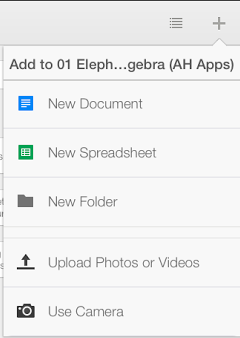 |
| Add a new file menu |
I have Google Drive's app on my phone and iPad and there is an option to take a photo and add it directly to a folder. I have a folder in my Google Drive titled "Student Work". When I see student work that I want to discuss with the class I navigate to that folder in my app, select "Use Camera" in the new document menu and I'm on to the next student.
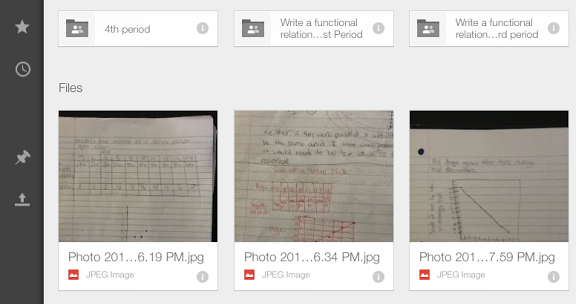 |
| View from within the app |
When we are ready to regroup I have that folder displayed on my projector and can easily annotate on them when needed through my computer software.
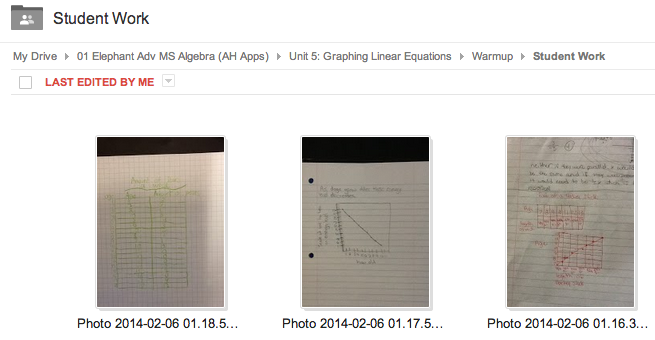 |
| View from my computer |
Thursday, January 30, 2014
Example of choice and a tiered activity to start class
A continued focus of my classroom this year has been to promote open ended questions that allow for student choice and creativity (yes in math class this is possible!). A learning target we have been working on recently has been determine if the coordinates of a given figure are vertices of a parallelogram or rectangle. Today in class I gave students three options and told them to choose the one that is the most challenging to them. (Some students did more than one)
Here were the three questions:
Here is the follow up discussion we had on #3, including the example a student came up with:
Here were the three questions:
I used this web app to check the points and get them displayed quickly as students shared them. As we moved through student work on each one it naturally sequenced our discussion to the higher level task #3 that some students chose to do. One kid even did the 'mind blown' motion with his hands when we substituted concrete values in for a and b in the student example below to show that it works. It was a pretty simple activity but at the same time a good motivator for some higher level discussions in math class that didn't take a whole lot of time to prepare.
- Write 4 coordinates that will make a parallelogram that is NOT a rectangle
- Write 4 coordinates that make a rectangle that has NO horizontal lines.
- Including the point (0,0), use variables a, b and c to symbolically write coordinates that will always make a parallelogram for any given values. For example maybe your coordinates would look like (0,0) (a,2b) (a,c), etc.
Here is the follow up discussion we had on #3, including the example a student came up with:
Student example: (0,0) (2a,b) (2a,0) (0,b)How did you come up with these?Choose values for the variables a,b, and c to show it works.What if we made a bigger or smaller? What would it do to the parallelogram?Would it still work if a or b were negative? How would it change it?Here is a link to the document of the activity.
Subscribe to:
Posts (Atom)
