Showing posts with label formative assessment. Show all posts

Tuesday, October 11, 2016

Independent and dependent variables with @Desmos classroom card sort


Today we did something cool with the Desmos classroom card sort lab. I wanted students to be able to identify an independent and dependent variable pair relationship and then determine which one was the independent (IV) and dependent (DV) by dragging each card onto the appropriate label.
I quickly realized how a tool like this can be used for a formative assessment when I displayed the teacher page on the screen for students while they were working. 
It doesn't tell them how they are incorrect but they were working hard to analyze where they were going wrong to try and get their name on the screen to go from red to green. Students either self-corrected or asked for help while others that completed the task moved on to the next screen in the activity.
On the next screen I had them move the pair relationship to a potential graph for the situation--same thing, anticipating a correct stack and giving feedback to kids that weren't there yet.
And finally, using the draw tool giving students a voice to disagree  with the predetermined graph for each set of cards if they feel like it doesn't fit with how they see the situation.
And of course this can always happen but you address it with those kids and continue to provide fun opportunities like this for kids to think deeper and interact on a more personal level with math.


Tuesday, October 1, 2013

Unpacking a student example of dividing by a fraction

Today in class students were choosing different practice activities for review for our test tomorrow. One pair of students was working on a worksheet that involved dividing an integer by a fraction. This is a topic we have not reviewed yet but that students have learned in past years. As I looked at his work I knew that I wanted him to explain his process to me. As I listened I knew this was something that I wanted to share. While some of his explanation is now based on procedures I really get the feeling that he has a deeper understanding than a student that is just taught to 'flip and multiply'.

In preparation for looking at it in a future lesson I tried to look at what is happening with the mathematics behind his explanation and what to do when a problem addressed is a little messier.

Comments, suggestions and additional strategies are welcome!


Here is the student's work from when he showed the class:

This is my take on what is happening as the student is moving forward with his procedure:


Monday, March 25, 2013

WiFli User Instructions


WiFli Response
Teacher instructions--3/22/2013

Installation

  1. Purchase from the wifliresponse.com website for $5
  2. Follow the installation process instructions while signed in to the account you plan to use the app with (make sure you are not signed in to two Google accounts within your browser as this may cause problems)
  3. You will receive a confirmation email with a direct link to the app once installation is complete

Daily Use

  1. Open the web app using a direct link, from wifliresponse.com or install the Chrome app.
    1. Note: Since this app uses Google Apps, Chrome will most likely deliver the best experience. Internet Explorer has been known to cause issues for some users.
  2. Start a question: The question itself will not be present within the app, only the answer choices (Options are A-G, Yes, No, Unsure or Other (which allows for single word or numerical response). The question will be asked aloud by the teacher, displayed on the board or on a handout in class. Confidence level and a free response options are also present within a question to allow for additional information to be collected for teacher use.


  1. If a question is open ended, leave the Set Answer box blank, otherwise enter a correct answer in the box prior to starting the question. 


  2. Share the response form with students on screen by clicking the Share button or embedding a link in your class resources. Clicking the Close button will return the user to the app. The Share screen allows for students to access the poll by shortened URL, an instructor tweeted link or scanning a QR code. The link is permanent for each teacher user and will not change with each poll. Students can bookmark the link on their own devices as well.
  3. Sort results by name, filter responses by answer choice or confidence level, or view only correct/incorrect responses.


  1. Seating chart: This can be helpful for a starting activity to group students by small groups, learning partners or other targeted interventions.
    1. Click on the Spreadsheet icon in the app and then click on the Seating Chart tab of the sheet. Follow the instructions on screen to set up a seating chart format. You will need to authorize the script the first time and then click it again to run it.
    2. Sort your current question data by a given category by clicking on the yellow cell and selecting (by confidence, answer, or correct)
    3. The chart will update for each class and each question that is asked. If you want to save a chart arrangement, use your computer’s software to do a screen capture.


  1. Response History
    1. At any given time the past 10 questions in history can be viewed within the app. To do so, click on the “1-recent” list and select a different value. Selecting 2, for example, would display the question that occurred before the current one.
    2. Click on ‘Go’ when you are ready to view the selected data.


  1. Class lists: Add your students, by class, to enable class data capture and identify students who have not responded
    Click the student icon in the web app. Follow instructions on the class list spreadsheet page
    Update class list periodically 
    The class list is used mainly to identify who has not responded and to identify what class is currently submitting. With a class identified you can actually save data points per class to a progress graph (probably something I should mention on the instructions page). The class list is the names that it will use to search for in student entered names on each response. Most of my class list names entered are just last names since it works off of a search function the list name needs to find itself within a student name entered. In other words if I have 'Schwen, Andrew' in my list and the student enters Schwen, Andy it will not identify them as submitting. If my list has just 'Schwen' both entries (Andrew and Andy) would be picked up. 

Friday, January 4, 2013

Class agenda for today


Three levels of activity today
For each lesson that I've been preparing this year I have been trying to have practice, review and extension options for each learning target. This unit I actually have the extensions ready to go ahead of time (probably having to do with us just having 10 days off). 

Our progression
We started the lesson a few days back with a large group investigation, following the golden ratio idea. Yesterday we did some more formal practice. Students that were rating themselves at an understanding or mastery level began to work individually on their practice material instead of staying with the large group. I used a couple clicker questions to help students identify how well they were understanding the material.

Student choice
We started in a similar fashion today and added a tier of activity for students that completed the practice yesterday in class--beginning work on extension activities for this learning target from a menu of choices (example). 
Throughout class I had students moving about the room, helping each other, asking me questions and digging deeper into the concepts. I love my job. 

Monday, December 17, 2012

What do I do when they haven't learned it?

What do we do when they don't learn it?
We know we are supposed to do it but how often do we actually intervene when a handful of kids don't learn what is old material? Sharon Kramer recently spoke at our staff meeting and suggested having a 4+1 or 9+1 model in the classroom and using the +1 day for reviewing or interventions. This is a direction I've been moving toward this year--calling those +1 days "workdays" with my students. Today I had a question up on the board of something I thought all students should be able to answer based on what we've learned up to this point:
How were my students identified for intervention?
Students submitted their answers using my student response system on their iPods. I looked at who answered incorrectly and then assigned the students that got the question wrong to a table and worked with them on some additional practice while the rest of the room worked or reviewed for our test tomorrow. If there was only one student that got it wrong I worked with them at my desk.
I had additional practice ready to go for those students and it was all electronic--it really didn't take more than 15 minutes to put it together. I used the projector for the class that had 8 kids and my computer screen for the classes with just 1 or 2 students. 
Why make our own tools for teaching?
I'm in the process of reworking my student response system to more closely match the needs in my classroom--one definite advantage of learning how to make our own tools as educators. Our classrooms are ever changing and we cannot wait for 'the perfect tool' to be dropped into our laps. Here are some charts of one class that I used to determine who I would be working with:

Friday, October 26, 2012

Using teachem for teachers and students

So I spoke with David Schnurman today about his teachem website that has quickly become one of my favorites. The site came just at the right time for me as I was finding a need for wanting students to interact more directly with some of the video resources I'd shared with them online. Basically the site allows me to embed a YouTube video and has notecards that snap to points within the video timeline and highlight as the video moves forward. Some of the cards I use to highlight information but I've found it to be a good way to extend what is said in the video and ask questions of the students as well. I can also provide feedback or a sample answer on the back of the card for them to view to check their thinking.
I'm sure I'll post more on how I'm using this soon but for now I've made a teachem school that I'd like to push some of my technology tutorial videos to for helping other teachers that are trying to use some of the templates I've shared. For those of us with YouTube blocked in our school buildings, it is a resource that our students will have to utilize at home for the time being.

Sunday, October 14, 2012

Data driven seating charts

I finished up what seems to be a working automatic seating chart creator. It is meant to be an add-on for those using my course management system. The idea is that after a given assessment or data point, a seating chart can be made to organize what will be happening in class that day with minimal time spent on creating the chart itself. A teacher could group by higher or lower ability or heterogeneous for peer-to-peer tutoring in a review session.
The new feature is included for those new to downloading my template but for those already using it you'll have to install a script:
  1. From your course management file menu choose "Tools" then "Script Editor".
  2. A new tab will open, in that tab click on the "File" menu, choose "New" and then "Script File"
  3. Call it "Seats" and paste in this code.
  4. After doing so, click the "save" icon and then in the "Run" menu, choose "installSeats". You may have to authorize the script and then make the selection again.
  5. You should have a new sheet on your system now titled "Seats".
  6. To make a chart, select a test in the yellow cell and then in the columns to the right type in numbers 1-(max of 60). The 1 represents the lowest score, and as you move up these represent students that performed better on the given assessment. After filling in all values for your largest class size, click the "Create Chart Formula" button--you may have to authorize the script and click it again.
  7. Now when you change classes and units in the dashboard sheet this chart will update based on your selections. If you want multiple arrangements just duplicate the sheet, reset it and do a different configuration.
Now Google really can make your seating charts!


Thursday, May 31, 2012

Mastery grade book


As I've accepted that the data entity I work with is now uniform and ever evolving it seems new ideas come up on a regular basis of how I can use it to inform instruction with the individual students in front of me in the classroom. The latest development has been the mastery grade book page.

Students initially take a pretest on the unit, becoming their current mastery level snapshot. As students begin the course work they submit future snapshots of their learning that replace the pretest score. I can choose what assignments to include or exclude at any given time as part of the grade percentage and any that are coded as 'Retake' replace the score that preceded it automatically in the calculation. I also have score column that reports an overall percentage of the work a student has completed that is independent of the exclude/include category.

If using the 'Final' category for an assessment, the 'Include' assignments work more as formative assessments where their scores are replaced after completion of a 'Final' (summative) unit assessment (In this scenario, a Retake following a Final would not replace the score however).

What this doesn't capture and what I can assure you is still happening in my classroom is higher level collaboration, problem-based learning and rich math discussions. This is simply a tool to give me another outside look at some of the data related to my students' learning.

Friday, April 27, 2012

Finding encouragement in discouraging data

I'll share some quick data that has been encouraging in a time that has also been stressful with the end of the year approaching...

We (myself and two other teachers) had a quiz that students took last week that didn't go so well. In the past we've required students to have mastered the learning targets before taking the test (best practice) but with state testing, finals and the end of the year approaching all students took the test on the same day (reality). The results were interesting. On the homework quizzes students had 61%, 71% and 40% on the learning targets (including students that have done corrections). The learning targets on the test came through at 65%, 71% and 43% respectively. I talked with my classes yesterday and it was helpful in demonstrating why I have them do reflections and corrections on their misunderstandings in our learning cycle.

I also looked at some data from our previous unit and thought I'd also share this graphic showing growth across the pretest, test and retake (for those students that retested):

Tuesday, April 17, 2012

Send students email results with one click

I am presenting on some Google tools I've made and use in my own classroom and share through this blog at the Flipped Conference 2012 and have set out to make the setup process easier for all teachers.
Background info if you care: In the past month or so I have set out to learn how to use Google Scripts. The documentation is written for the non-programmer in mind (although I found having taken a college computer science class 13 years ago helpful) and offers MANY examples of how to implement specific functions. Basically anything you can possibly imagine in Google Apps can be done through the functions present there.
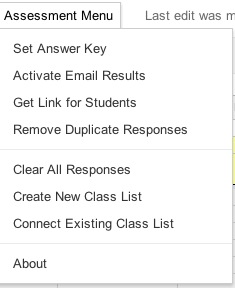
An update I've made to my templates is to now allow instant email results be activated from the menu rather than myself or others having to follow some tech-savvy like instructions. Here's two images of the menu, before and after the email trigger has been set:


Another feature I'm currently testing is course level table of contents creation, including folders and test filing in course and unit folders. I have it working but want to make sure before adding that to the public template. My vision on setting out with this update was that teachers would never again have to enter in a spreadsheet ID number, copy and paste answers or manually gather test links for students. (In presenting the material to other educators that always seemed to be the step that was the most difficult to follow. )They will still have to collect and give access to other course materials and activities though...

Saturday, March 10, 2012

Class list integration is now automatic!!


 So my wife is gone tonight which translates to me having all evening to learn more about Google Apps Scripts. I found some new functions tonight that should help new users of my template to be able to create and connect a class list file with nothing more than a menu selection.(Reduces one page of directions down to one click!) Users who download the template can now set up their class list by selecting "Create Class List" in the Assessment Menu. It will automatically create a spreadsheet titled "Class Lists" and connect it to the assessment template by its Key ID. (Teachers will still have to edit the class list with their student names.) The first row will be the class titles and it will accommodate up to 10 columns of student lists as before.
Very excited about this. Very excited.

Wednesday, January 25, 2012

iGoogle: A personal, custom dashboard


Recently I've been frustrated with wanting to embed Google gadgets into a Sites page. You get this really easy script but Sites won't (easily) accept scripts in their pages. As I was playing around in some gadgets I had embedded in my templates, I happened to click on "Add this gadget to iGoogle" and my life changed ( a bit ).
It throws that gadget that I only can view into my personal iGoogle page full of gadgets. Now that I have a dashboard that can pull from various data sources, one gadget can be used to display that data set in iGoogle...this is getting really techie sounding, so let me summarize in teacher language:
Students take a chapter 8 test, in my dashboard (see it here) I set it display student growth from the pretest to the chapter 8 test. Since I have the chapter 8 test selected, this will update my graphs on my iGoogle page. Next chapter, when I change to view the chapter 9 results, my iGoogle page will update as well. You can also make separate tabs to sort your gadgets by function. Most charts in my WiFli Response System are gadgets so I have a tab to view those as well.
The coolest part? You can share an iGoogle page with others (like people that teach the same courses) and they will see the graphs too as long as they have view rights to the data it is displaying--a great visual dashboard for collaborative team discussions. I also have my collaborative team agenda (see a post on it here) set to use gadgets now and those can be included in an iGoogle page as well. Some other gadgets I'm using that aren't mine are a weather forecast, recent google documents feed, gmail inbox and calendars.
Things to note: 
By default, the gadgets update every 5 minutes. If you want sooner you can get it down to 1 minute (still better than the 24 hour wait many have to accept by current edtech companies that make dashboards).
Have the tab open you are wanting the gadget to go to. I've had trouble changing a gadget to another tab once it's there.

Thursday, January 5, 2012

Flipped Class: Building connections, small groups and customized learning.

I love my job if I haven't made that clear in earlier posts. Don't get me wrong, there are still difficult moments but today has proven to be very encouraging. I'm a year into a fully-flipped classroom with my Geometry students and I had another moment today that encouraged me in my walk.
I've developed a student response system, WiFli Response,  that I've begun using for my attendance process in class (no seating charts since students are moving about constantly based on their learning activities).
The response system presents students a generic form that can be used to collect and display for me some graphic data instantly: 1) Who has not responded--both absent and off-task students; 2) Confidence level on the given objective; 3) Response to a specific question; and 4) Any additional comments they'd like to add.
This week I've presented these questions at the start of class and ask students to submit their answers prior to the start of class using web devices and our wifi network:

Submit your attendance on your iPod today.
1. For the question, answer “yes” if you watched all the 8.1 videos and “no” if you did not.
2. Rate how you feel today on a scale of 1 to 5 (5 being amazing, 1 being worst day ever)
3. In the free response section feel free to add anything (appropriate) here that you like :) It’d be helpful to know of any specific Geometry help you’ll need today too.
I've truly enjoyed some of the additional comments students are willing to give and it helps me in knowing who to connect with on a more individual basis within a class period. Comments from having no sleep last night, feeling overwhelmed, personal issues, or my personal favorite today:

My rabbit chewed up one of my books past night! GOod thing I got a kindle
After attendance, based on how students answered the questions I worked with a small group of students in the front of the room who were needing some extra assistance. Class started with them feeling completely lost and ended with them reporting much higher confidence in the material. Because of the flipped class nature, the remainder of the class did not have to wait to learn new material--they were able to move on to the next lesson.

Thursday, December 29, 2011

WiFli Student Response System

In conclusion to my Open letter to an edtech company series (here and here) I've launched a website this week that releases my own student response system: WiFli Student Response Sytem (www.wifliresponse.com) The platform is cloud-based and works through Google Forms and Spreadsheets. For access, the system relies on either student owned or classroom sets of computers or other web-enabled devices.

Dashboard View

The cost is considerably less than some of the fees being charged by other edtech companies (less than 1%) and I feel that the data returned is much more useful in directing immediate classroom instruction for individual and groups of students. Another positive in my mind is that it does not rely on a third-party (besides Google anyway) to run and you will own the student data in your own personal Google account.

The results are integrated into a single-view dashboard appearance with data filtering options, student confidence level and overall correct percentages (see image above). Within the dashboard there is a history of 10 questions that can be seen for after class reflection by the teacher. No editing is required by the end-user but there are some options available like integrating a class list to show who has not yet responded--it can also detect which class is submitting answers and unlike other web-based student response systems the teacher has the option to set the correct answer in the question set.

I've priced it at $5 for a single user trying to keep it comparable to an app price. The cost is a one-time fee and only needs to be payed by the teacher, the students will access it by one link shared for an entire school year. School and district pricing options are also available with a little humor in the pricing for edtech companies.

Saturday, December 10, 2011

A potential classroom edtech game-changer

Finding myself frustrated with an edtech vendor and their products, I went on to create a product suited for my specific classroom needs and more importantly-- much cheaper. (Read my open letter on the subject here.) Without giving all the details away, I'm at the point where I can say a little more about what I'm talking about.
I've created a student response system, contained entirely in Google Forms and Spreadsheets. Different from other Forms I've created, this one requires no maintenance or customization and can be used "out of the box" by anyone comfortable sharing a link with their students. There are of course some advanced features that can be enabled like a teacher class list connection. In this feature, the dashboard has the ability to detect which class is submitting a response at a given time and generate a list for me on my teacher machine of students that have not yet responded. Other results include displays of self-reported student confidence vs. correct answer, response time vs. confidence and a data table that has drop-down menu filtering.
Benefits of such an idea for me are that for the life of my classroom (until something better comes along) I'm only using this single file. I post the form link once on my class website and then never again. It will pull data for the most recent response set and allow a teacher to see the past 9 questions in history as well. As far as #BYOD goes (Bring your own device), it will work on any device that has internet access, period. Students will not have to find an app to download and it can be bookmarked on a device or computer for fast future access. With this change I believe school districts do not have to be subject to steep vendor prices and can begin to invest in multipurpose technology hardware.
I'm looking into how best to release something like this as making money on technology is relatively new to me. Considering I am using Google products to create it maybe that complicates things as far as selling it would go. If that's the case then I can always just give it away for free.

Wednesday, October 26, 2011

Flipclass, Differentiation and Moving the Boulder

I've had the chance to work with three different groups in the past week and a half on the flipclass concept. I've enjoyed the conversations and idea sharing that has taken place. In person the idea makes a lot more sense than in the 140 character tweets many of us are limited to. I'm far from an expert and only offer my perspective of what has seemed to work for me in my own classroom. I'm cursed/blessed with being a teacher that is reflective. The blessing being that is what helps us strive to continually improve our practice; the curse in that we never rest or are satisfied with what we've attained.
My own classroom has been traditional in nature from the beginning of my teaching career 9 years ago. It always seemed that every year was a starting over process and little time was left for making the class better (adding application activities, projects, investigations). Essentially I felt like Sisyphus having to start pushing the boulder back up the hill each fall.
Through Twitter, Blogs, and recently reading a lot about the Common Core Standards I know that I need to move students beyond the traditional algorithms, lecture/drill/kill methods and into a deeper understanding of the mathematics (my content area). I've always wanted to offer differentiated instruction but being one teacher with a limited class period I've never known how to really put it into practice. As I move more into the flipclass I feel those things can become more of a reality and here are my reasons:
1. Students come with a common knowledge base. Having watched the videos prior to class the next day, more students are able to participate in discussions in class and less dependent on me, the curriculum "expert".
2. Activities focused on depth. For a course like geometry, much of the terminology and concepts are new ideas. Rather than spend time on going over the lower level vocabulary and basic knowledge skills in class we can get right to application. Time is spent on things like a real-world photo scavenger hunt, Geometer Sketchpad labs and games with small groups to acquire deeper understanding of the concepts.
3. Small groups and focused interventions. Yesterday I had the chance to work with a small group on a topic they were still having difficulty with from the previous unit--the PLC question of "What do we do when they don't understand it?" This question was always a struggle because some of the class does understand it and if a teacher needs to move to the next material or stay on the old material one group is being left out. As I was working with the remedial group, I still had a chance to move about the room and talk with other students. I found that some of the class was not only moving on to the next area of learning, they were 3 lessons ahead of others. They stated that they really liked having the freedom to do so.
4. Formative data assists in gathering baseline data of student understanding. Note: this is not the only demonstration of understanding students have to complete. To get at least some kind of data on student learning while students are working in different places, I have used my google forms template to give feedback to students on some of the concepts they are learning and gather data on overall class understanding. This is used to help guide our large group discussions and focus on areas where it is clear the whole the class is still struggling. Students are able to rework mistakes immediately toward the correct answer and then get help if they are still confused. This has helped students self-identify in the learning process if they truly are understanding it.
Final thoughts:
I'm still learning and growing. What I'm most excited about is moving toward a role as a teacher of connecting more with individual students, having small group conversations to gather an understanding of their learning process and building on the course each year to make it better. My version of the flip uses video to deliver a large portion of the direct instruction. Now that those are done I can focus on bringing in rich activities for students to apply and create material in the content.
For those critical of the flipclass idea I would just ask what are your solutions for when students don't understand the material, are absent from class, need to see/hear things more often than others or already understand the material you are covering? Flipclass is a work in progress for me at attempting to address these issues as a classroom teacher.

Tuesday, September 6, 2011

First Day of School

We had our first day of school today. A new strategy I'm implementing this year is pretesting. I've often heard of the instructional value (and research confirmed results) of such a practice and am happy to have moved my classroom in that direction.
I just checked in with the results in the Google Form spreadsheet and it is great to see what areas the whole class is already proficient as well as some of the individuals that are proficient on learning targets beyond the general population of their peers. Students were told to check the results email after sending their responses and record it on their paper copy of the pretest. The results can be used for differentiated activities in class in the next two weeks.
I'm excited about the early student reflection and awareness of what they have yet to learn in the pretesting process.