Showing posts with label open ended question. Show all posts

Wednesday, May 7, 2014

Open-ended discussion on "Rules of exponents"

So earlier this week I read this post by Andrew Stadel and was challenged to approach the rules of exponents in a more perplexing way. First of all, starting with the mistakes and what kids already know about exponents was a great launching point for this lesson. I made my own 4 question mistakes not really wanting to get into exponents of zero, negative values or fractions just yet.
The following statements are all INCORRECT.1. Identify the mistake(s).2. Correct.3. Justify (show) your reasoning.
1. 43 · 42 = 165
2. (34)2 = 36
3. x3 · x2 = x6
4. x2y3 = (xy)5
We spend a large majority of the time on question 1 in the last hour and somehow managed to get to fractional exponents. Different from earlier classes today, I started my last class by saying there are two levels of answering these questions:
1) You grab a calculator and find the value of each side and say "These numbers are different, so it's wrong".
2) You apply what you already know about exponents and come up with an explanation that someone who knows less 
than you about exponents can understand. 
For number 1 I had students say that the value should be 45, 210 and  322
The fun came in asking students to explain why 45 was the same as 210 in visual form. Most at first said that because you take half the base number you must double the exponent but we needed to know why to develop their understanding. 
One student explained by pairing up the two's to make 4's by multiplication and stating there were 5 groups of these pairs--the whole class applauded his explanation after gasping that they got it.
So then we went to why 45 was the same as 322 and a girl student did this (again applause from the class followed):
Realizing we were getting dangerously close to logarithms in my 6th grade Algebra class I pushed the envelope and asked what the exponent would be in 8x = 45  and they jumped right in!! Some students naturally assumed it was 2.5 and stopped but others weren't satisfied. 

A girl student in class offered to come up and draw a picture of what she thought was happening and we got this to look at as a class:
Her picture was an excellent launching point for discussion in thinking about what to do with left-over factors when we try to group to get factors of 8. Her mistake actually brought out a big difference in fractions vs fractions as exponents when another student tried what she said in his calculator. The class came to consensus that for the exponent, since it would take 3-2's to make another factor of eight the exponent should actually be 3 1/3 instead of 3 1/4. 

Wow. Great class, fully engaged students and some great thinking going on driven by the students.


Thursday, May 1, 2014

Reverse it to see what they know

We are working on solving systems of equations in Algebra class right now. As a class warmup today I asked students to do this:
Write a system of equations that has a solution of (3,-2) that you think most (all) students would think it is easiest solved using the linear combination [elimination] method.
It was really fun to see their thinking and push back on them a little bit with--"Hmm...I'm not sure if I'd solve that one with  linear combinations. You haven't made it appealing enough to me yet." What I love about tasks like this is some students do it exactly in the way I was hoping based on what we've already done in class and others do something more intuitive (and sometimes simpler) than what I had in mind.

We started our unit of solving linear systems with this activity and I have been really happy with the deeper understanding students have had because of the greater focus on the properties of equality. In a couple classes we even looked at doing similar operations using matrices and ideas from my college linear algebra class. (I think I went through that course hardly knowing why I could do what I did to those matrices and hated how much notebook paper it took to do it...)

Here are a couple of examples of what students said in class today when I talked with them and asked them to share their process with the class:

Hayden: 
I started with 3x = 9 because I wanted x=3 and then I made the equation x + y = 1 because that equation was easy to have the correct solution.
3x = 9 (starts in the middle of the problem in a way)
x = 3 
x + y = 1  (back to the beginning)
Then I made 2x - y = 8 because the 2x would give me the 3x I needed and the 8 would make the 9 when I combine the equations.
x + y = 1  
2x - y = 8 (manipulating the y's to cancel and to get his 3x = 9 situation)
The y's would also make zero to make someone want to use the combinations method.


Lucy: 
I just made up some numbers on the left side and put in the coordinates to see what they would evaluate to:
2x + 3y --> 2(3) + 3(-2) = 0 so the equation 2x + 3y = 0 has a solution of (3,-2).
Then I made the next equation to have a -2x because I wanted the x's to cancel when I do combinations and the y-term could be anything. I put in the coordinate again to see what the number on the right side of the equation had to be:
-2x + (anything)y = whatever you get back
-2x + 4y --> -2(3) + 4(-2) = -14 so then the equation -2x + 4y = -14 also has a solution of (3,-2).
I wasn't sure how well the activity would go but the student seemed very engaged from the start and those that I talked to had great strategies in how to go about solving the problem.
It didn't take a whole lot of planning up front and it gave the students the opportunity to be creative and come up with unique products that demonstrate their understanding of the concept in the reverse direction. 
I believe that in doing so students will also have a better understanding of when to use the combinations method instead of the substitution or graphing method when appropriate.


Friday, March 7, 2014

Triangle Inequality: Introducing a learning target in context

In starting a new unit today I wanted to give context to students for writing inequalities. In our algebra class students have not yet learned the triangle inequality theorem which states that:
The sum of any two sides in a triangle must be greater than the third side.
Seems like a great opportunity for some 'ruler math'. I kept the rulers on my desk until after the bell because spring break starts after today and I know how middle schoolers can we with unstructured time and these tools...

In anticipating the pacing to be different for each student I made  the activity as a Google presentation and provided students the link, instructing them to do their work on paper and answer completely any questions asked of them in the activity--noting that I would be breaking in periodically to the whole class and facilitating some discussion.


My favorite part was #4 of the first drawing where many of them grew frustrated with not being able to construct a 1 cm, 2 cm, 5 cm triangle--thinking it was something they were doing wrong. Kind of a fun way to watch them squirm and I know I'm not the first math teacher to have ever done this.

I had some awesome conversations with students while they were working. One student changed what he said mid-sentence. He went from saying
"The two lengths need to be at least the length of the third...The two lengths need to be more than the third length..." 
I asked him why he changed his wording and he explained the difference between the two correctly. Pretty cool--I made sure to highlight that to the class in our whole group time. This kind of mathematics is so much more fun to teach than the traditional "do this, copy me, don't think" style. I overheard the same student above before leaving say to his neighbor
"Math is my hardest class because you can't just memorize stuff and copy it down. You actually have to understand the concepts to do well." 
I told him I will take that as a compliment.

I am not expecting all students to go here but I am hoping that some make some connections to they pythagorean theorem and how it relates to acute and obtuse triangles in the last slide.

I've already made some revisions to the activity since teaching it one period and I wouldn't be surprised if it changed a little more as the day goes on. As always I'm open to other ideas or revisions to make it a better experience for my students.

Wednesday, February 26, 2014

Another (low prep) open ended set of questions

Again--nothing fancy here and hopefully that is the point. We did another set of tiered questions for a lesson warmup today to pre assess and to scaffold on their existing knowledge. Students could choose which question they wanted to do and we made connections along the way through each one.
Here is the set of questions:
Choose one of the following examples to do:
1. In the equation 4x + 3y = 13, what is the value of y when x=1.5?
2. Rewrite the equation 4x + 3y = 13 in y=mx+b form.
3. Rewrite the equation y-c=c(x+3) in y=mx+b form.
I flat out told students that the easiest is #1 and the most challenging is #3. We have not done any work to this point with solving an equation for a variable when more than 1 variable is present. The student that solved and explained #1 lays the groundwork for what the class will hear for the student that chose #2 and so on. Before the activity students were not ready to answer any question related to #3 but by the end of the discussion the whole class had something to build on for determining the slope and y-intercept present in #3.
Students overall appreciate being able to choose and will often go for the more challenging level (at their ability) when that choice is present. It also helps in leading the lesson more naturally and organically than just a teacher lecture prepared in advance.

Thursday, January 30, 2014

Example of choice and a tiered activity to start class

A continued focus of my classroom this year has been to promote open ended questions that allow for student choice and creativity (yes in math class this is possible!). A learning target we have been working on recently has been determine if the coordinates of a given figure are vertices of a parallelogram or rectangle. Today in class I gave students three options and told them to choose the one that is the most challenging to them. (Some students did more than one)
Here were the three questions:
  1. Write 4 coordinates that will make a parallelogram that is NOT a rectangle
  2. Write 4 coordinates that make a rectangle that has NO horizontal lines.
  3. Including the point (0,0), use variables a, b and c to symbolically write coordinates that will always make a parallelogram for any given values. For example maybe your coordinates would look like (0,0) (a,2b) (a,c), etc.
I used this web app to check the points and get them displayed quickly as students shared them. As we moved through student work on each one it naturally sequenced our discussion to the higher level task #3 that some students chose to do. One kid even did the 'mind blown' motion with his hands when we substituted concrete values in for a and b in the student example below to show that it works. It was a pretty simple activity but at the same time a good motivator for some higher level discussions in math class that didn't take a whole lot of time to prepare.

Here is the follow up discussion we had on #3, including the example a student came up with:
Student example: (0,0) (2a,b) (2a,0) (0,b)How did you come up with these?Choose values for the variables a,b, and c to show it works.What if we made a bigger or smaller? What would it do to the parallelogram?Would it still work if a or b were negative? How would it change it?
Here is a link to the document of the activity.
 

Wednesday, December 4, 2013

Polygon angle sum theorem and the distributive property

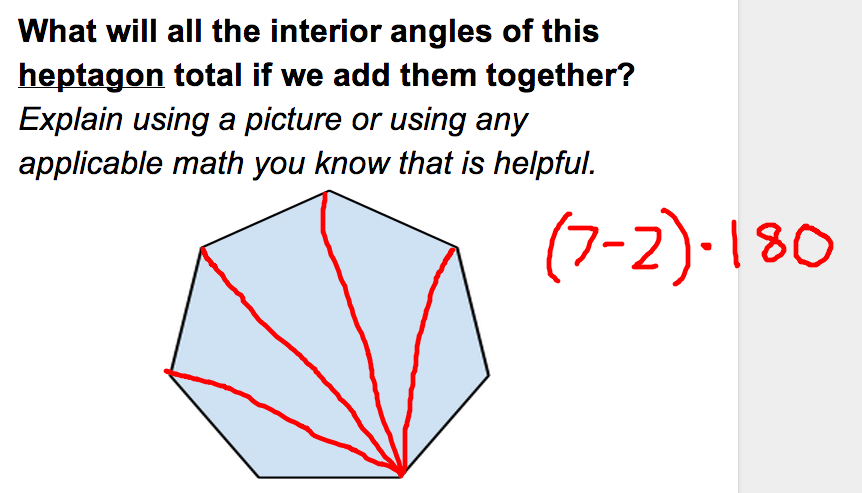
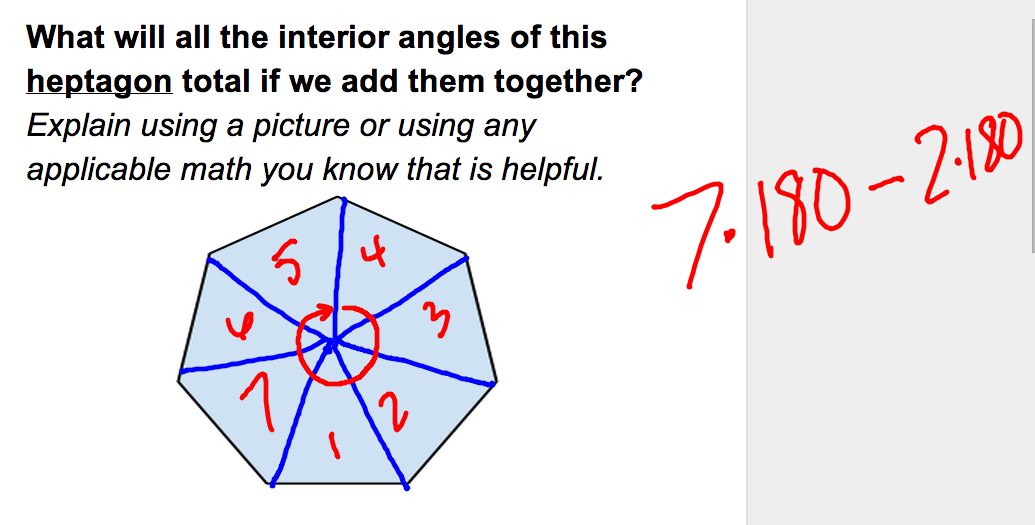
We did this in class today as a warmup activity. I've always led students toward the first example but we made kind of a cool connection to the distributive property when we tried to make a student's picture work when they drew the triangles from the center of the figure instead of from a vertex.

In the first example all angles in the triangle add to the total measure of the polygon.


In the second example, the interior angles for the triangles (center) do not make up any of the polygon interior angles so we subtract them. To make the connection rather than writing it as 360 I wrote it as 2•180.